Commercial air conditioning carries a legal duty to leak check and keep records. That duty sits with you, not your maintenance company. We are F-Gas qualified and we cover the South West.
Most business owners have no idea this applies to them. If your premises has split air conditioning, VRF or VRV, chillers, packaged AC, commercial refrigeration or heat pumps, you are an F-Gas operator in the eyes of the law.
And here is the part that catches people out: outsourcing your maintenance does not transfer that duty. You can pay a contractor to service the kit, but the legal obligation to have it leak checked and to keep the records stays with you. When the Environment Agency asks for your logbook, they ask you, not your contractor.
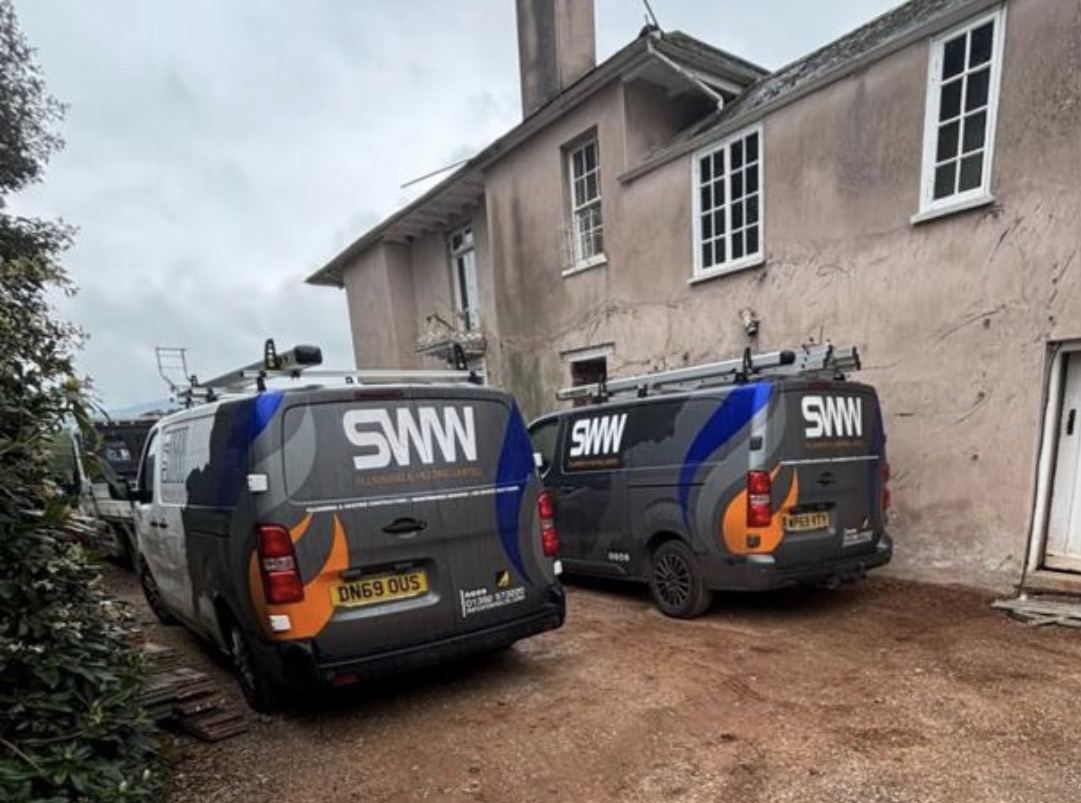
SWW is F-Gas qualified and we carry out leak checks, record keeping and repairs across Exeter, Devon and the South West.
This is the bit almost everyone gets wrong. It is measured in tonnes of CO2 equivalent, not kilograms and not kilowatts.
Leak check at least every 12 months. To put that in perspective, around 2.4kg of R410A is enough to cross the line, which covers just about every commercial system above a small wall-mounted office split.
Leak check at least every six months.
Leak check at least every three months, and a fixed automatic leak detection system must be installed.
If you have a working automatic leak detection system, the interval between checks doubles.
For any system at or above 5 tonnes CO2e you must keep records, and keep them for five years. Refrigerant type and quantity at installation, anything added during maintenance, the dates and results of every leak check, the name and certificate number of whoever carried it out, and what happened to the gas at end of life.
In practice, most sites have this scattered across a drawer of service sheets from three different contractors. That is not a record, and it is not going to help you when someone asks.
We keep a proper logbook per system and hand you a signed report after every visit, so when it is asked for, it exists.
The F-Gas phase-down caps how much high-GWP refrigerant can be sold each year, and it tightens every year. If your systems run on R410A, servicing them is going to keep getting dearer, and at some point the economics tip over into replacement.
Newer systems run on R32, which has roughly a third of the global warming potential and is not being squeezed the same way. We will tell you honestly where your kit sits on that curve, and whether you are better off maintaining it or planning to replace it.
If your premises has air conditioning, refrigeration, a chiller or a heat pump containing fluorinated refrigerant, then yes. You are the operator, and the duties sit with you. It does not matter whether you own the building or lease it, and it does not matter that a contractor maintains the equipment.
It depends on the refrigerant charge, measured in tonnes of CO2 equivalent rather than kilograms. Systems at 5 tonnes CO2e or more need checking at least annually, 50 tonnes or more every six months, and 500 tonnes or more every three months with automatic leak detection fitted. Around 2.4kg of R410A is enough to pass the 5 tonne threshold, so most commercial systems are in scope.
Only if they hold a valid F-Gas qualification. Any work involving refrigerant handling has to be done by a certified engineer. We are F-Gas qualified, and our certificate number goes on your records, which is exactly what an inspector will want to see.
For any system at or above 5 tonnes CO2e: the refrigerant type and quantity installed, anything added during maintenance, dates and results of all leak checks, details of the companies who worked on it, and how the gas was recovered at end of life. Keep them for five years and produce them on request.
F-Gas duties are enforced by the Environment Agency, and non-compliance carries civil penalties. The more common outcome, though, is that it surfaces at the worst moment, such as during a lease negotiation, a sale, or an insurance claim, when someone asks for records that do not exist.
That is a separate requirement. Air conditioning systems with an effective rated output above 12kW must be inspected by an accredited energy assessor at intervals of no more than five years under TM44. It is a different regime from F-Gas leak checking, and it is worth knowing you may need both.
F-Gas qualified installation for homes and businesses across Exeter and Devon.
Washroom refurbishment and full interior fit out across the South West.
Heat pump installation with the Boiler Upgrade Scheme grant deducted from your quote.
Exeter · Topsham · Exmouth · Crediton · Cullompton · Tiverton · Newton Abbot · Honiton · Dawlish · Teignmouth